

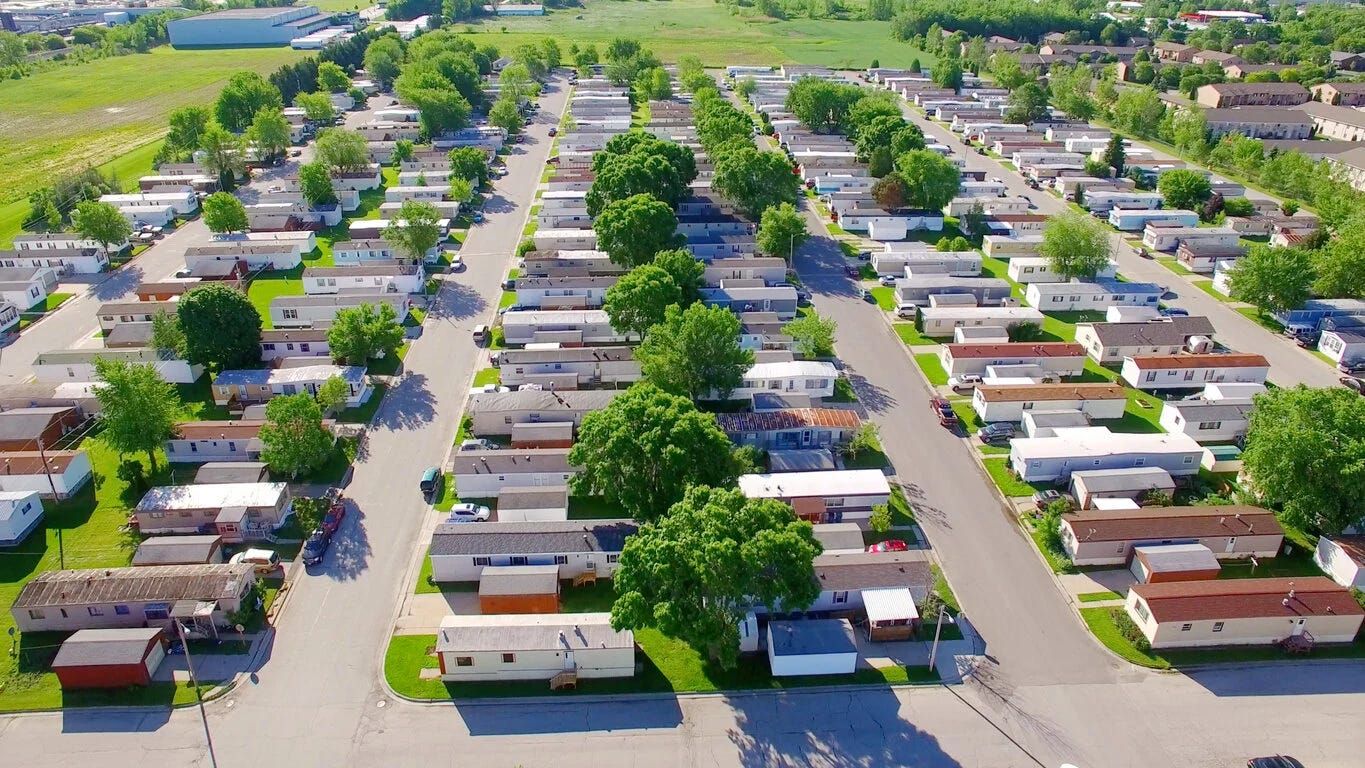
Photo from Midwest Park Capital
While everyone fights over luxury apartments and Class A office space, the smartest real estate investors are quietly earning 20%+ returns on investments most people won’t even consider: mobile home parks. The numbers tell a striking story - while traditional multifamily properties struggle to hit 7% cap rates, mobile home park investors routinely see 10%+ returns with significantly lower operating costs.
This isn’t about taking advantage of anyone. It’s about recognizing a massive market inefficiency created by status bias and outdated assumptions. The data shows mobile home parks offer some of the most stable cash flow in real estate, with tenant retention rates that luxury apartment operators can only dream about.
The opportunity is hidden in plain sight, protected by zoning laws that make new competition nearly impossible, and supported by demographics that virtually guarantee growing demand. Let’s break down why the smart money is moving into this overlooked sector.
Why Your Real Estate Mentor is Dead Wrong
The conventional wisdom says to chase Class A properties in prime locations. That advice is costing investors serious money. Let’s run the numbers on a $1 million investment:
Class A Apartment Building
7% cap rate = $70,000 annual NOI
60% annual turnover
High maintenance costs
Competitive market
Mobile Home Park
10% cap rate = $100,000 annual NOI
10-15% annual turnover
Lower maintenance (tenants own homes)
Protected market
That’s a $30,000 annual difference in net operating income before even considering the reduced operating costs and higher tenant stability. Over a 10-year hold period, that’s $300,000 in additional profit - and that’s being conservative.
The Perfect Storm Nobody Sees Coming
Demographics and economics are creating unprecedented demand for affordable housing options. The numbers are staggering:
7.6 million more adults over 55 by 2025
Median home prices up 28% since 2019
Average apartment rents increasing 15%+ annually in many markets
Nearly zero new mobile home park supply
Meanwhile, the existing supply of mobile home parks is shrinking. Cities are shutting down older parks, and getting approval for new ones is nearly impossible. Basic economics tells us what happens when demand increases while supply decreases: values go up.
Add in inflation pushing more people toward affordable housing options, and you have perfect conditions for sustained growth in this sector.
Why Your Tenants Never Leave (And That’s Good)
Traditional apartment investors celebrate 40% annual turnover as “good.” Mobile home park operators routinely see 85-90% of their tenants stay put each year. Why? Because moving a mobile home isn’t mobile at all - it costs $5,000-$7,000 to move one.
Let’s calculate the impact:
100-unit property - Apartments: 60 turnovers × $1,000 cost = $60,000 annual turnover expense - Mobile Home Park: 15 turnovers × $200 cost = $3,000 annual turnover expense
That’s $57,000 in annual savings before considering lost rent during turnover periods. This stability creates a predictable cash flow that lenders love.
The Government Is Your Friend (For Once)
Local governments have inadvertently created one of the strongest competitive moats in real estate. Strict zoning laws and NIMBY (Not In My Back Yard) opposition make building new mobile home parks nearly impossible. Fewer than 10 new parks are built annually nationwide.
Compare that to apartments:
400,000+ new apartment units annually
Fewer than 1,000 new mobile home lots annually
50,000 existing mobile home parks nationwide
Numbers decreasing yearly due to redevelopment
This supply-demand imbalance creates natural appreciation and rising rents with virtually zero new competition. It’s practically government-protected cash flow.
How to 10X Your Returns Without Being a Slumlord
Modern mobile home park operation is about professional community management, not exploitative practices. Simple operational improvements deliver massive ROI
Professional Management Upgrades
Online payment systems: 15% reduction in late payments
Professional website: 25% higher qualified leads
Standardized maintenance: 30% cost reduction
Community amenities: 20% rent premium
Initial investment in modernization typically runs $50,000-$100,000 but can increase NOI by $75,000-$150,000 annually through higher occupancy, reduced costs, and justified rent increases.
The Time to Act Is Now
Major institutional investors are waking up to this opportunity. Blackstone just acquired 40 communities in one transaction. But there’s still time for individual investors to capitalize on this inefficient market.
The choice is simple: Chase increasingly competitive returns in traditional real estate, or earn superior cash flow in a protected market with growing demand. Sure, some people might raise an eyebrow when you say you own a mobile home park. But they probably won’t notice you counting your money.
The wealth-building opportunity in mobile home parks is too significant to ignore because of outdated perceptions. The numbers don’t lie - and they’re spectacular.